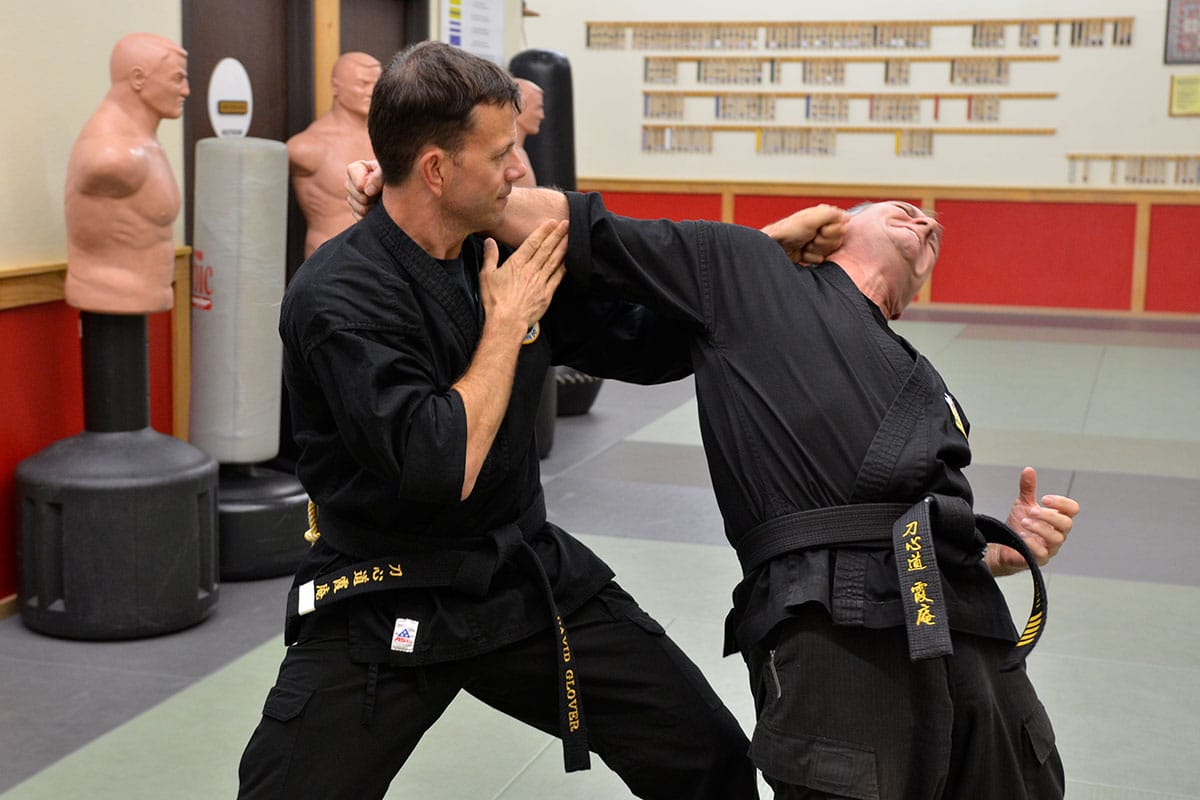
David as a Martial Arts Student
I am entering my 13th year of ninjutsu training—the self-protection systems associated with the Japanese ninja—as a transformative path for living more peacefully, safely, and skillfully in the modern world. For me, ninjutsu is not a sport or a hobby. It is a long-term practice of perception, decision-making, and embodied discipline: learning to relate to engage with uncertainty with greater clarity, restraint, and responsiveness.
As Toshitsugu Takamatsu wrote, “Ninjutsu epitomizes the fullest concept of self-protection through martial training in that the ninja art deals with the protection of not only the physical body, but the mind and spirit as well.” I take this seriously—not as ideology, but as a practical orientation. The aim is not aggression or domination. The aim is self-protection understood broadly: awareness, boundary-setting, movement competence, and the capacity to de-escalate, escape, or respond when necessary.
I currently train with Dennis Mahoney and Theresa Murphy of Shinobi Martial Arts in New Hampshire.
How I think about ninjutsu
Most people’s image of “self-defense” is technique-centered: what to do to someone. My experience has been that effective self-protection is more often ecology-centered: how to perceive a situation early, perceive intent, recognize what is happening, and choose actions that reduce risk.
This is one reason ninjutsu has remained compelling. The practice invites you to study not only the mechanics of movement but also context—distance, timing, terrain, attention, fatigue, emotion, social dynamics, and the way possibilities for action change moment to moment. Over time, training becomes less about accumulating moves and more about refining perception.
In ecological terms, I think of training as learning how to expand affordances; in other words, what actions are possible in a given moment. For me, martial arts practice has become a form of research where technique is knowledge and practice is a site of knowledge.
In my own words
Why did I become a martial arts practitioner?
After a committed and lengthy deep dive into the world of triathlon—as an athlete, coach, and race director—I experienced burnout, overtraining, and injury in 2008, which ultimately led me to stop competing in 2010. That period forced a re-evaluation of how I understood discipline and achievement, and it widened my interest from performance outcomes to sustainable practice.
In 2014, I began training in ninjutsu and have remained committed to it ever since. What started as a new embodied practice became something deeper: a path of personal transformation and a framework for studying awareness, adaptability, and self-regulation. Ninjutsu became central enough to inform my doctoral research, not because it is exotic or romantic, but because it offers a rigorous way to examine how humans learn to perceive and navigate risk, uncertainty, and interpersonal dynamics.
What do I mean by “transformative path”?
I mean transformation in a concrete sense: changes in how I pay attention, how I manage stress, how I set boundaries, and how I relate to conflict—internally and externally. Training regularly exposes gaps between intention and action. It also develops capacities that transfer beyond the training floor: composure under pressure, sensitivity to context, and the ability to respond without escalation.
In that way, martial arts can function as a technology of the self: a structured practice through which a person cultivates specific modes of perception, conduct, and ethical restraint. The goal is not to become more dangerous. The goal is to become harder to target, less reactive, and better able to choose the least harmful, most effective option.